

SINGAPORE: What started as a simple request for a meal has sparked widespread discussion online about dignity, food security and the everyday realities faced by domestic helpers in Singapore.
A screenshot circulating on social media shows a domestic helper asking her employer if she could cook a single egg to eat with leftover rice from the day before. The message was polite and restrained, framed around hunger rather than entitlement. The employer’s reply was short and unequivocal: permission was denied.
The exchange did not end there. In a follow-up message, the helper apologised repeatedly and said she would replace the egg by borrowing one from a friend in the same building, promising to return it on her next rest day. For many who saw the conversation, that apology was the most troubling part.
Food, Hunger and Power Dynamics in the Household
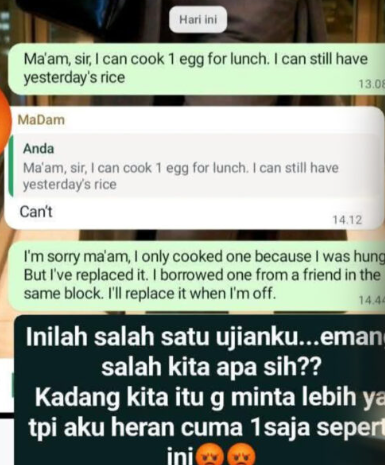
The screenshot was shared in a Facebook group frequented by domestic helpers, with a caption expressing frustration and sadness over the situation. The post quickly attracted attention from both helpers and employers, many of whom questioned how something as basic as an egg could become a point of conflict.
Several commenters highlighted that food is not a luxury item, especially for live-in domestic workers who rely entirely on their employers for daily meals. They questioned how someone could be expected to work efficiently while feeling hungry, adding that adequate food provision should be a given, not something that requires approval.
Some employers joined the discussion to share contrasting experiences, explaining that their helpers are free to eat whatever is bought for the household. A few even mentioned intentionally buying extra groceries to ensure their helpers feel included and well-fed, viewing it as basic respect rather than generosity.
Legal Obligations and Employment Standards in Singapore
Beyond emotional reactions, others pointed to employment rules and regulations. Under Singapore’s employment framework, employers are required to provide sufficient food for their domestic helpers. Commenters stressed that denying basic meals could potentially cross into non-compliance, especially when the food in question is minimal and inexpensive.
Eggs, rice and vegetables were frequently mentioned as staples that should never be rationed to the point of refusal. Some urged helpers facing similar situations to seek advice or assistance through appropriate channels if food deprivation becomes a pattern rather than a one-off incident.
At the same time, there were reminders not to generalise all employers. Several helpers commented that they felt fortunate to work in households where meals were never restricted and where they were treated as part of the family.
A Wider Conversation About Dignity and Respect
What resonated most strongly was not the cost of the egg, but what the refusal symbolised. For many readers, the incident highlighted the imbalance of power within employer–helper relationships, especially when basic needs become conditional.
In households where domestic helpers live and work under the same roof, access to food is directly tied to well-being, job performance and self-worth. When a worker feels compelled to apologise for being hungry, it raises uncomfortable questions about boundaries and humanity.
The viral reaction suggests that this is not just about groceries. It is about empathy, ethical employment and recognising that domestic helpers are workers deserving of dignity. As the online discussion continues, many are left reflecting on a simple but powerful idea: no one should have to ask permission to eat when they are hungry.