

Global gold prices staged a strong rebound after falling to a near one-month low, with the precious metal climbing sharply as investors reacted to political uncertainty in the United States and shifting expectations around interest rates.
Spot gold jumped by more than 3 per cent during the latest trading session, reaching approximately US$4,837 per ounce. Based on current exchange rates, that works out to roughly S$6,530 per ounce, highlighting the continued strength of the commodity in international markets.
The surge comes after gold briefly pulled back from record levels in the previous session. Earlier in the year, the precious metal had soared to an all-time high of about US$5,594 per ounce, equivalent to around S$7,550.
Market analysts say the latest price movement reflects growing demand for safe-haven assets amid ongoing economic uncertainty.
PRECIOUS METALS RALLY ALONGSIDE GOLD
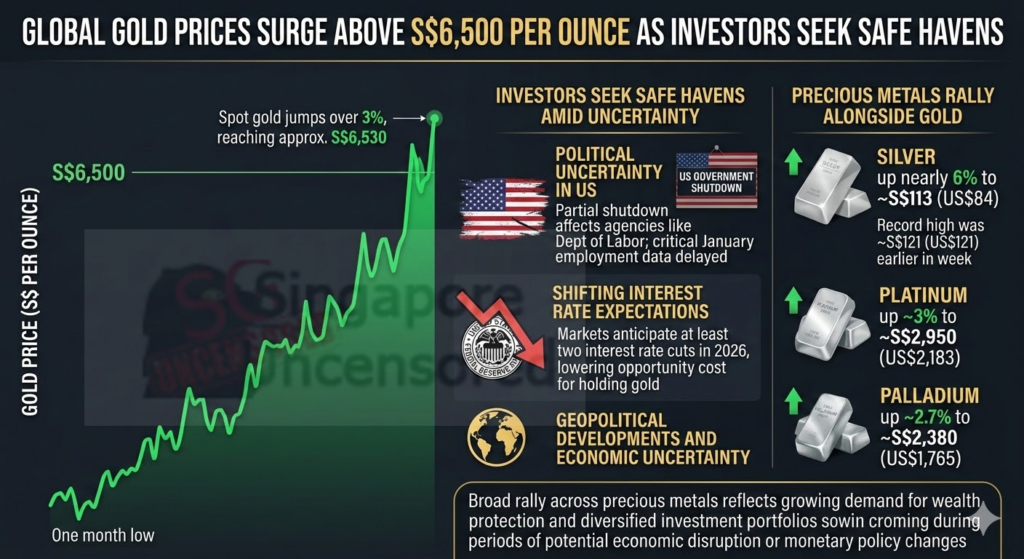
Gold was not the only precious metal to gain ground during the session. Several other commodities also recorded significant increases as investors adjusted their portfolios.
Silver posted one of the largest gains, rising nearly 6 per cent to about US$84 per ounce, or roughly S$113. The metal had recently reached a record high of about US$121 per ounce earlier in the week.
Platinum prices also climbed by around 3 per cent to approximately US$2,183 per ounce, equivalent to about S$2,950. Palladium saw a smaller increase of around 2.7 per cent, trading near US$1,765 per ounce, or roughly S$2,380.
The broad rally across precious metals suggests investors are increasingly seeking assets perceived as stable during periods of financial uncertainty.
Financial analysts say such movements often occur when markets expect economic disruptions or potential changes in monetary policy.
US GOVERNMENT SHUTDOWN CREATES MARKET UNCERTAINTY
One of the key factors influencing gold prices is the partial shutdown of the United States federal government. The shutdown began after lawmakers failed to reach a funding agreement before the deadline, leaving several government agencies unable to operate fully.
Among the affected agencies is the US Department of Labor, which typically releases closely watched economic indicators such as employment reports.
Due to the shutdown, the January employment data will not be released as scheduled. Investors often rely on these reports to gauge the health of the world’s largest economy and anticipate central bank policy decisions.
Without fresh data, traders have turned their attention to broader economic signals and geopolitical developments.
EXPECTATIONS OF LOWER INTEREST RATES SUPPORT GOLD
Despite the political uncertainty, the US dollar has remained relatively firm after stronger-than-expected economic indicators were released earlier.
However, investors are also closely watching developments at the US Federal Reserve following the announcement of a new central bank chair.
Market expectations currently point towards the possibility of at least two interest rate cuts in 2026. Lower interest rates generally benefit gold prices because the metal does not produce interest income.
When borrowing costs decline, the opportunity cost of holding gold also falls, making it more attractive compared with interest-bearing assets such as bonds.
For many investors, this combination of geopolitical uncertainty, potential policy changes and shifting economic conditions continues to drive demand for precious metals as part of long-term wealth protection and diversified investment portfolios.