

A job listing linked to Singapore has gone viral across Malaysia and beyond, after offering a surprisingly high salary for a toilet cleaning role—paired with an unexpected requirement for applicants to hold a university degree.
The advertisement, widely shared on social media, has drawn a mix of amusement and confusion, with many questioning the rationale behind such hiring criteria.
The listing reportedly offers a basic monthly salary ranging from S$3,200 to S$3,300, which converts to roughly S$3,200–S$3,300 in local terms. With overtime included, the pay could rise to between S$3,500 and S$4,000—figures that stand out for a role typically classified under manual labour.
The job scope includes general cleaning duties such as maintaining toilets and operating cleaning equipment across multiple locations islandwide.
Degree Requirement Raises Eyebrows Online
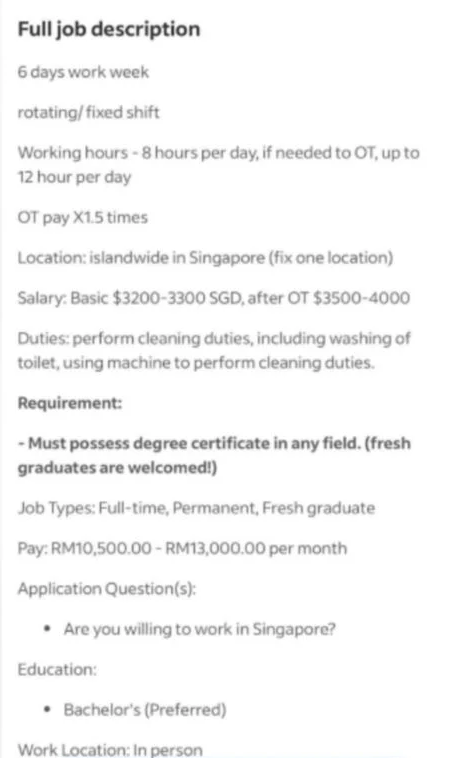
While the salary attracted attention, it was the requirement for candidates to possess a degree in any field that sparked the strongest reactions.
Many online users questioned the necessity of formal academic qualifications for such a role, with some joking that years spent in university would ultimately lead to cleaning duties. Others raised concerns about whether such requirements reflect broader issues in the job market.
Comments circulating online included queries about how a degree would improve cleaning performance, while others sarcastically labelled the position as one of the “most academically qualified” cleaning roles in the region.
The contrast between the qualification requirement and the nature of the job has fuelled wider discussions about hiring practices, especially in cross-border employment contexts.
Foreign Labour Policies May Explain Hiring Criteria
Despite the unusual requirement, the listing appears to be influenced by Singapore’s structured foreign labour framework.
In Singapore, lower-skilled foreign workers are typically hired under Work Permits, which are subject to quotas and levies imposed on employers. However, degree holders may qualify for higher-tier passes such as S Passes or Employment Passes, which come with different cost structures and regulatory conditions.
This creates a potential incentive for employers to set higher qualification requirements—even for roles that do not traditionally require them—in order to access a different category of foreign workforce.
As a result, hiring a degree holder could, in some cases, offer operational or financial advantages to employers.
Pay Still Attractive Despite Controversy
Despite the debate, some observers noted that the salary remains attractive, particularly when compared to similar roles in neighbouring countries. Overtime pay, typically calculated at 1.5 times the hourly rate, further boosts overall earnings.
For job seekers, especially those considering overseas employment, such compensation packages may still be appealing regardless of the qualification requirements.
However, the viral reaction highlights a broader conversation about job matching, skills utilisation, and whether academic qualifications are being appropriately aligned with roles in today’s labour market.
As discussions continue, the listing serves as a reminder of how policy frameworks, economic incentives, and public perception can intersect in unexpected ways—sometimes producing headlines that capture attention across borders.